

Why Small Business Threat Detection Can’t Wait Until It’s Too Late
Small business threat detection is the process of identifying and stopping cyberattacks before they cause serious damage — and right now, it’s one of the most urgent issues facing business owners across the U.S.
Here’s a quick look at the best tools for detecting threats in a small business environment:
| Tool Type | Best For | Complexity | Cost Range |
|---|---|---|---|
| Next-Gen Antivirus (NGAV) | Endpoint protection | Low | $$ |
| EDR (Endpoint Detection & Response) | Monitoring + automated response | Low-Medium | $$ |
| SIEM | Log analysis + alert correlation | High | $$$ |
| MDR (Managed Detection & Response) | 24/7 outsourced monitoring | Low (managed) | $$$ |
| DNS Protection | Blocking malicious domains | Low | $ |
| AI-Powered Threat Intelligence | Proactive threat hunting | Medium | $$-$$$ |
The numbers are hard to ignore. 73% of small and mid-sized businesses experienced a data breach or cyberattack in 2023. Small businesses account for 43% of all cyberattacks worldwide — yet most assume they’re too small to be a target. That assumption is exactly what attackers count on.
And it’s getting more expensive. For businesses with fewer than 500 employees, the average cost of a data breach has grown to $3.31 million — a 13.4% jump in recent years.
The threat isn’t coming someday. For many small businesses, it’s already here.
What makes this worse is timing. 76% of cyberattacks happen after hours or on weekends — when no one is watching. Ransomware doesn’t take days off. Neither do phishing campaigns or credential stuffing attacks. Without a system actively monitoring your environment around the clock, you may not know something went wrong until the damage is done.
A real-world example makes this painfully clear: one boutique retail business suffered a full data breach after attackers quietly exploited an outdated point-of-sale system. A local law firm had sensitive client data exposed because a single employee clicked the wrong email. These aren’t rare edge cases — they’re everyday stories.
I’m Tony Bojko, owner of Sail-On Enterprises LLC, and I’ve spent years helping small businesses navigate the overlap between IT infrastructure and real-world security — including building practical small business threat detection strategies that don’t require an enterprise budget or an in-house security team. In the sections ahead, I’ll walk you through the tools, stages, and cost-effective approaches that can make a real difference for your business.
Understanding the Landscape of Small Business Threat Detection
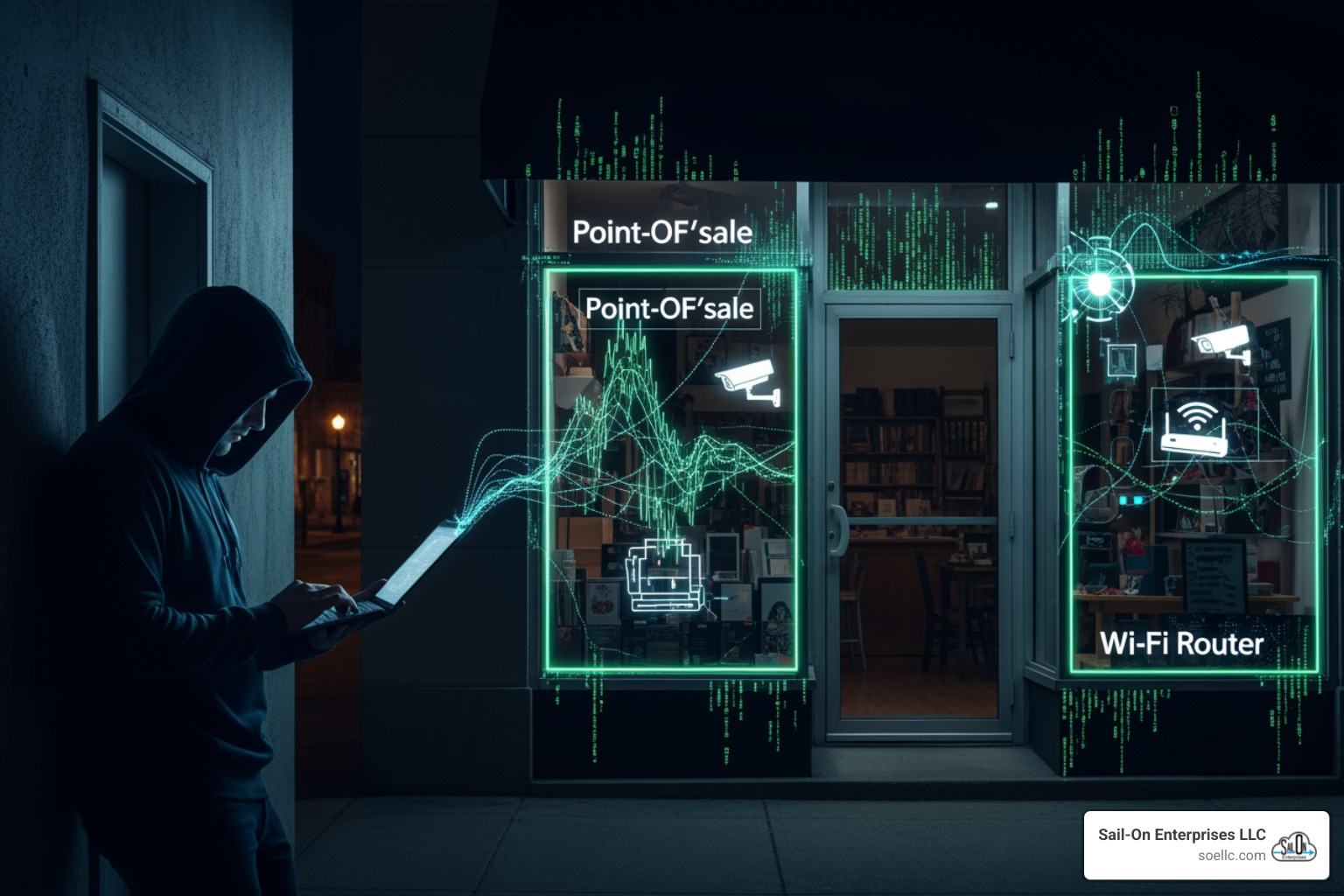
When we talk about the threat landscape in May 2026, we have to move past the image of a lone hacker in a hoodie. Today’s threats are automated, AI-driven, and highly organized. Despite making up nearly half of all cyberattacks globally, many small businesses in Tulsa still operate under the “security through obscurity” myth. They think, “Why would they want my data?”
The truth is, your data is a commodity. Whether it’s employee social security numbers, customer credit card info, or just access to your bank account, it all has a price. Furthermore, as we move more of our operations to the web, the “attack surface”—the number of ways a hacker can get in—grows. If you are operating in the cloud, your security perimeter is no longer just your office walls; it’s every login and every connected device.
The Critical Need for TDR in 2026
Threat Detection and Response (TDR) isn’t just a fancy acronym; it’s a survival strategy. The “dwell time”—the period an attacker spends inside your network before being caught—can often stretch into months. During this time, they aren’t just looking around; they are stealing credentials and planting ransomware.
The financial impact of a breach is often the “bleed” that kills a small business. Beyond the immediate ransom or recovery costs, there is the long-term damage to your reputation. If your clients can’t trust you with their data, they won’t trust you with their business. Investing in TDR is about moving from a reactive “hope for the best” stance to a proactive “detect and defend” posture.
Common Cyber Threats Facing SMBs Today
- Phishing: Still the #1 entry point. It only takes one tired employee on a Friday afternoon to click a “password reset” link that isn’t real.
- Ransomware: 63% of small businesses now face advanced ransomware threats. These attacks encrypt your files and demand payment, often after stealing the data first to use as leverage.
- Identity-Based Attacks: Compromised identities are involved in the vast majority of breaches. VPN abuse, for instance, accounts for a staggering 43% of identity-related security incidents.
- DDoS and Insider Threats: Whether it’s an external actor flooding your site with traffic or a disgruntled former employee with lingering access, these threats can paralyze your operations.
To stay ahead, modern businesses are turning to scientific research on network detection to close the gaps that traditional firewalls simply can’t see.
The 7 Stages of the Threat Detection and Response Process
Effective small business threat detection follows a specific lifecycle. You can’t just buy a software package and call it a day. It’s a process that ensures if something does get through, you have a plan to stop the bleeding.
- Detection: Identifying that a potential threat is present using tools like EDR or SIEM.
- Investigation: Determining if the alert is a “false positive” or a real attack.
- Containment: Isolating the affected systems so the “fire” doesn’t spread to the rest of the network.
- Eradication: Removing the threat entirely—deleting malware, closing backdoors, and resetting compromised passwords.
- Recovery: Restoring systems from clean backups and getting back to work. This is why you need 3 reasons to keep your systems up to date and backed up.
- Reporting: Documenting the incident for insurance, legal, or regulatory purposes.
- Risk Mitigation: Learning from the event to ensure it never happens again.
Proactive vs. Reactive Security Postures
A reactive posture is like waiting for your house to catch fire before buying a smoke detector. A proactive posture involves “threat hunting”—looking for signs of trouble before an alarm even goes off. By using behavioral analytics and anomaly detection, we can spot patterns that don’t fit the norm. For example, if an employee who usually logs in from Tulsa suddenly attempts to access the server from an IP address in another country at 3 AM, the system should automatically flag and block that attempt. Leveraging scientific research on SMB threat intelligence allows us to see these forming threats before they hit your front door.
Achieving Regulatory Compliance Through Detection
If you handle credit cards, you need to follow PCI DSS. If you’re in healthcare, HIPAA is your bible. For businesses with customers in California or Europe, CCPA and GDPR apply. These regulations aren’t just suggestions; they are legal requirements that often mandate specific levels of threat monitoring and data protection. Proper threat detection helps you prove to auditors that you are taking “reasonable steps” to protect sensitive information, potentially saving you from massive fines.
Essential Tools for Modern Small Business Threat Detection
The tools you used five years ago won’t cut it in 2026. Legacy antivirus is like a “Wanted” poster; it only recognizes criminals it has seen before. Modern threats change their “faces” constantly.
| Feature | Legacy Antivirus | Next-Gen EDR |
|---|---|---|
| Detection Method | Signature-based (known threats) | Behavioral/AI (unknown threats) |
| Response | Delete/Quarantine file | Isolate host/Rollback changes |
| Visibility | Limited to files | Full system/Network telemetry |
| Offline Protection | Weak | Strong (AI runs locally) |
For those with technical expertise, exploring scientific research on autonomous security agents can provide insights into how self-hosted, AI-powered tools are democratizing enterprise-grade security for the “little guy.”
Leveraging AI and Machine Learning for Faster Response
AI has collapsed the skill barrier for attackers, but it has also given us better shields. Machine learning can establish a “baseline” of what normal activity looks like in your business. When something deviates from that baseline—like a sudden mass-encryption of files (a hallmark of ransomware)—the AI can trigger an automated blocking response in milliseconds. This is especially critical for web-facing assets; check out WordPress Security: What You Need to Do Now to Protect Your Website for specific tips on protecting your online storefront.
Network and Identity-Based Detection Solutions
We often say that “identity is the new perimeter.” In a world of remote work, we can’t just rely on the office firewall. We need Zero Trust Architecture—the idea that no user or device is trusted by default, even if they are already “inside” the network. This includes:
- Multi-Factor Authentication (MFA): A non-negotiable requirement in 2026.
- DNS Protection: Blocking access to known malicious websites at the “phonebook” level of the internet.
- Global Intelligence: Using scientific research on global threat intelligence to stay informed about which threat actors are currently targeting your specific industry.
Cost-Effective Strategies for Limited IT Resources

One of the biggest hurdles for small businesses is the price tag. You don’t have a million-dollar security budget, and you shouldn’t need one. The key is resource optimization. Instead of buying every tool on the market, focus on the ones that provide the highest ROI.
We often recommend a “layered” approach. Start with the basics and add complexity as you grow. You can find more on this in our guide: 3 Tips to Reducing Your Tech Costs Overview.
Balancing Cybersecurity Costs with Effective Protection
Cybersecurity is a recurring operational expense, not a one-time purchase. Think of it like insurance or accounting. A good rule of thumb for small businesses is to look at “per-endpoint” pricing. For roughly $25 per computer per month, you can often get managed patching, active monitoring, and next-gen protection. This is a drop in the bucket compared to the $3.31 million average cost of a breach. For businesses in our neck of the woods, looking into scientific research on Tulsa network security support can help you find local experts who understand the regional threat landscape.
Implementing Detection Without a Large Security Team
You don’t need a 24/7 “War Room” staffed by twenty experts. Automation and Managed Detection and Response (MDR) allow you to “rent” a security team. These services monitor your alerts and only call you when there is a real problem that requires your attention. User-friendly consoles also make it easier for your existing IT staff (even if that’s just one person) to see what’s happening. If you’re unsure where your vulnerabilities lie, scientific research on penetration testing can provide a “stress test” for your current defenses.
Best Practices for Small Business Threat Detection
Technology is only half the battle. The most sophisticated small business threat detection system in the world can be undone by a single weak password or a misplaced sticky note.
Building a Culture of Security Awareness
Your employees are your first line of defense—or your greatest vulnerability. Regular training is essential. This doesn’t mean boring 3-hour lectures; it means:
- Phishing Simulations: Sending “fake” phishing emails to see who clicks, then providing immediate, friendly training for those who do.
- Password Hygiene: Moving away from “Password123” and toward passphrases and password managers.
- Social Engineering Awareness: Teaching staff to be skeptical of “urgent” requests for wire transfers or sensitive data, even if they appear to come from the boss.
Don’t forget the technical side of email security, either. Implementing DMARC helps prevent attackers from spoofing your domain and sending emails that look like they’re from you.
Continuous Improvement and Vulnerability Management
Security is a process of constant refinement.
- Patching: 43% of identity incidents involve VPN abuse, often exploiting unpatched vulnerabilities. Keep your software updated!
- Asset Discovery: You can’t protect what you don’t know you have. Regularly audit your network for “shadow IT”—unauthorized devices or cloud apps being used by employees.
- Audit Logs: Keep records of who accessed what and when. This is vital for the “Investigation” stage of TDR.
Frequently Asked Questions about SMB Cybersecurity
What is the difference between TDR and EDR?
Think of EDR (Endpoint Detection and Response) as the tool—the software that sits on your laptops and servers. TDR (Threat Detection and Response) is the overall strategy and process that uses EDR, along with network monitoring and human expertise, to manage threats across your entire business.
Is threat detection affordable for a business with under 50 employees?
Yes! In fact, it’s often more affordable than the alternative. Many cloud-based security solutions offer “pay-as-you-go” models that scale with your headcount. For a small team, the cost is often less than a monthly coffee budget per employee.
Why do most cyberattacks on small businesses happen after hours?
Attackers aren’t just being mean; they’re being strategic. They know that small businesses are less likely to have someone monitoring the network at 2 AM on a Sunday. This gives them a “head start” to encrypt files and delete backups before anyone notices on Monday morning. Automated detection tools are the only way to counter this “after-hours” advantage.
Conclusion
At Sail-On Enterprises LLC, we believe that being a small business shouldn’t mean being a “small target.” We are proud to provide Tulsa-based businesses with the enterprise-level IT support and marketing services they need to grow safely.
Cybersecurity can feel overwhelming, but it doesn’t have to be. By focusing on the 7 stages of TDR, leveraging AI-powered tools, and building a culture of awareness, you can “stop the bleed” and protect the business you’ve worked so hard to build. Whether you need a full security audit or just want to make sure your backups are actually working, we’re here to help.
Learn more about our comprehensive IT services and let’s make sure your business is ready for whatever 2026 throws its way.